


Fast bowling is one of the main aspects of cricket, also known as pace bowling. Fast bowlers deliver the ball at high speed which challenges the batsman. These high speeds reduce the reaction time for batters, contributing to the success of fast bowlers (Bartlett et al., 1996). It is a unique skill which requires a lot of intense training, more than any other position in cricket.
Fast bowlers are generally prone to injury because of their bowling speed and movements. They convert linear momentum into angular momentum during the delivery stride and transfer it to the ball’s linear velocity at release (King et al., 2016; Salter et al., 2007). During their run-up, the bowler converts their forward motion into a twisting motion. This conversion helps add speed to the ball when they let go of it.
To minimise injury and increase performance, a proper periodised training should be followed. This training should include all the sport specific needs. These elements help in performance enhancement. Fast bowling is a blend of speed, strength, power, endurance, agility, flexibility and mobility.
How on-ground conditioning plays a major role in fast bowling:
The faster the bowling arm comes over, the faster the ball comes. Plyometric training shows a significant increase in throwing distance, resting heart rate and bowling velocity. These are a series of functional exercises performed at high volume to stimulate movement and position.
Incorporating plyometric exercises like skipping, lateral hopping, jumping lunges, bounding can help in performance development. In earlier research, it is stated that training programs which include both conditioning and skill training improve shoulder muscular strength. They also enhance cardio respiratory endurance, physiological, and psycho-motor ability.
The relationship between lower body strength and fast bowling speed is significant. This is due to power generation, front foot impact, bowling speed, and technical efficiency. As a result, training programs for fast bowlers include exercises such as squats and lunges. These exercises target the muscle that generates force and speed in bowling action. Kettlebells also can be excellent fast bowling training devices particularly for the lower body. When a kettlebell swing is performed it improves explosive power in hips, buttocks and legs.
On the other hand, Isotonic weight training is very important for fast bowlers. It includes concentric and eccentric actions. During these actions, muscle contracts and lengthens.
An example for weight training program
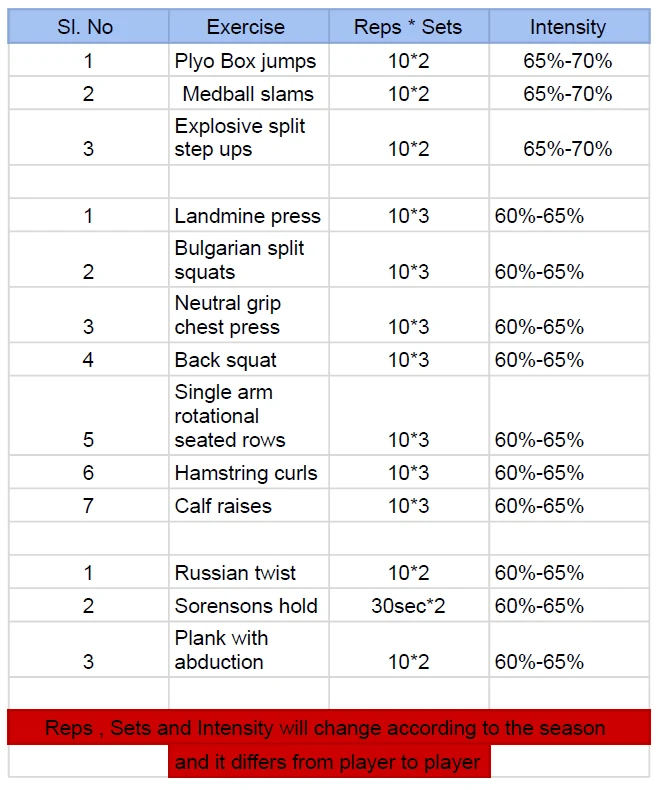
A significant percentage of the experts believe that all conditioning areas can be maintained. They think these areas can be improved during the in-season of a busy international or domestic cricket season. They claim that this can be achieved by performing one high intensity session every 10 days. Furthermore, the experts suggest that all these qualities can be trained or maintained through playing the game. The exception is strength, which requires additional focus.
However, in reality, pacers require conditioning and training throughout the year to ensure that in-season conditioning doesn’t cause injuries. 30% of Ballistic six programs can be used as a warm-up. This is safe and increases performance rapidly. Agility, speed, flexibility, mobility and stability are other on-ground sessions which help in performance enhancement for fast bowlers.
Injury prevention:
As said earlier, fast bowlers are easily prone to injuries when compared to other players in cricket. Because of their movement patterns which includes eccentric and concentric actions at high speed, velocity and power. A proper warm up and cool down should be followed before and after a training session. Warm-up and cool down should include sports specific movements. Cool down should focus on the muscles involved during activity.
Lower back, Rotator cuff, Elbow, Knee, hips, obliques, ankle and finger injuries are the most common among fast bowlers.
All these should be strengthened properly during conditioning sessions. Prioritizing sports specific movements is one of best ways to prevent injuries.
Conclusion:
In conclusion, on-ground sessions are important for fast bowlers to develop their physical, physiological and psycho-motor abilities. On the whole, individualized training plans should be designed according to each players needs and position.
No two people are the same. Each person differs from another. Therefore, the principle of individualisation plays a major role in designing a program. Always ensure that fast bowlers maintain peak fitness. This helps in their playing ability and prevents injuries. It also leads to their long-term player development.
References:
Sarkar,D., & Dhapola, M,S, Effect Of Twelve-week Plyometric Training On Selected Physiological and Skill Related Performance Variables of Male Medium Fast Bowlers in Cricket.
Pont, I. (2013). Fast Bowler’s Bible. Crowood. Hayath, H., & Spargoli, G. (2016).
The immediate effects of different intensities of upper limb plyometric warm-up on bowling speed in cricketers. Preliminary results. Scienza Riabilitativa, 18(1),16-23.
Andrews, M. H., Gorman, A. D., & Crowther, R. H. (2024). Functional movement variability to maintain delivery speed in cricket fast bowling. European Journal of Sport Science, 24(4), 415-421.
Singh, D. (2024). A relationship study between fast bowling velocity and lower body strength. Journal of Sports Science and Nutrition, 5(1), 37-39.
Author – Keren Kirubai, Strength & Conditioning Coach
